Biopharma outlook 2024
During 2023, the returns of the biopharmaceutical sector, despite its promising prospects, were weighed down by concerns over rising yields and the fear that the regulations introduced by the U.S. Inflation Reduction Act—which will allow Medicare (the federal health insurance program) to negotiate drug costs directly and impose actual price caps—could have a significant impact on corporate profit growth. By the last quarter of the year, the outlook for biopharmaceutical companies had improved significantly, with the possibility that quotations could recover decisively in 2024.
The rise in long-term yields clearly makes it more difficult for stocks, particularly biotech ones considered more sensitive to the higher cost of capital needed to finance expensive research and development operations, to compete with relatively risk-free assets like bonds, since potential future gains are now discounted at a higher rate.
The valuations of biotechnology companies are strongly correlated with the 10-year yield, which serves as the preferred discount rate. As the chart shows, there is indeed a robust negative correlation between the yield curve's trajectory and the fortunes of the biotech industry.
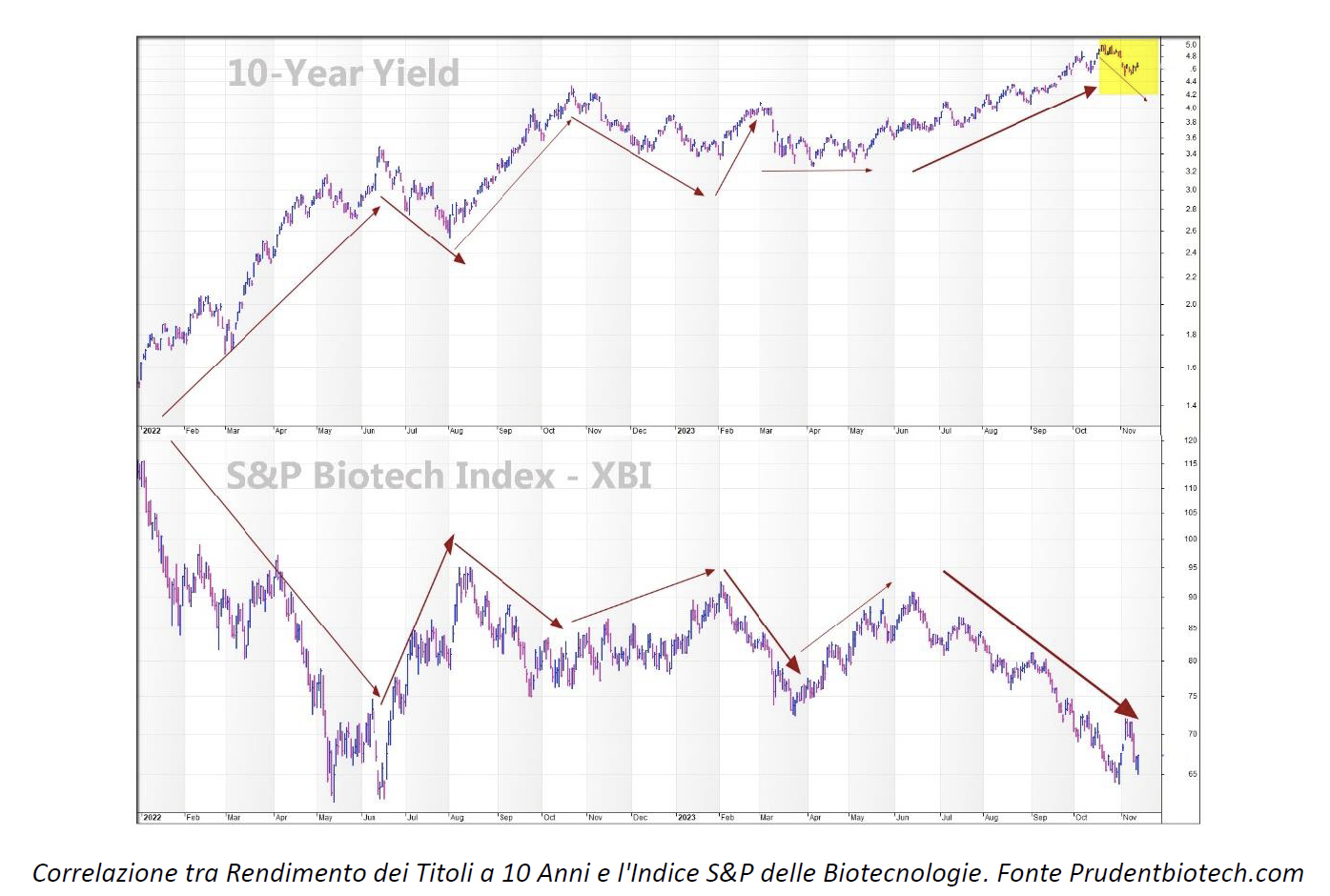
The 10-year yield curve has shown an upward trend since April of this year, reaching a peak of 5% at the end of October. Yields then began to decline as October's economic data showed a slowdown in inflation and the Federal Reserve indicated a patient approach to further increases. However, this year's challenges have strengthened biopharmaceutical and pharmaceutical companies.
Biotech firms, in particular, have become more resilient, better equipped, and well-prepared for the future. They have worked diligently to improve their strategic planning, adopting a comprehensive vision that integrates short-term operational needs with long-term market considerations. They have taken an increasingly cross-functional perspective, focusing on the entire development process and the market dynamics awaiting their products.
The first theme for 2024, therefore, suggests that relatively low valuations and changed expectations in the interest rate environment could serve as strong catalysts for a rapid sector reversal.
Regulatory and Political Context
Except for the previously mentioned Inflation Reduction Act, the global regulatory and political environment has seen a clear improvement. The risk of clinical failures has decreased thanks to more effective cooperation between companies and regulatory bodies. In the United States, the so-called "priority designation" has significantly reduced review times and procedures for drugs. The GAIN Act for antibiotics and the Orphan Drug Act for rare diseases are good examples of how regulatory incentives can encourage progress in specific therapeutic areas. Similar legislation, aimed at granting companies longer market exclusivity and tax benefits, has also been approved in Asia and Europe. Politics is the factor most likely to impact healthcare sector sentiment in 2024, which will be a major election year in countries representing 80% of global market capitalisation, 60% of GDP, and 40% of the world's population (Taiwan, Indonesia, Russia, Korea, India, South Africa, EU, Mexico, United States, United Kingdom).
The most important electoral outcome for the sector will undoubtedly be the U.S. presidential election, where it is well known that politicians on both sides of the aisle have always used healthcare spending to gain voter support. However, history has consistently shown that the healthcare sector can withstand political rhetoric. Even when policies that appeared to alter the system were enacted—such as the Affordable Care Act or the drug pricing provisions of the Inflation Reduction Act—companies have always found ways to innovate and grow. Moreover, given their key role in resolving the COVID-19 pandemic, the sector is now viewed more favourably by the general public.
Demographic Trends and AI
The demographic trend remains one of the most interesting investment themes in healthcare. With the ageing population increasing, the number of people suffering from age-related diseases will inevitably rise: longer and healthier lives represent an extraordinary victory for society, but they also bring greater prevalence of conditions such as dementia, cancer, or metabolic diseases. Recent breakthroughs in Alzheimer's treatments and two new drugs for diabetes and obesity will radically change the fight against a series of chronic diseases and open up, for these indications alone, a market worth more than $100 billion by 2030.
Neurosciences, genomics, and biotechnology in general are destined to be the big winners in the adoption of artificial intelligence. AI models will examine enormous volumes of healthcare data—such as clinical studies, brain mapping, and genetic information—and analyse them far faster than humans can. The AI-based healthcare market, which was worth $9 billion in 2022, is expected to reach $188 billion by 2031.
M&A
What emerged at the recent "London Healthcare Conference" confirms that a growing percentage of healthcare executives (about 70% of those surveyed) expect a strong recovery in mergers and acquisitions after two years of relatively subdued activity. In 2022, the number and average size of global healthcare mergers and acquisitions decreased by more than 30% and about 15%, respectively, as companies adopted a wait-and-see approach amid high market uncertainty, a trend that continued into 2023, with global M&A value showing a moderate recovery. Recent estimates indicate that the global pharmaceutical industry has $700 billion in cash ready to be invested in acquisition deals and research and development.
Conclusions
After a two-year consolidation phase, biotech stocks could find a more favourable environment in 2024 thanks to the anticipated decline in interest rates. Low valuations for many companies, an improving risk context, potential new mergers and acquisitions, and a shift in investor sentiment position the biopharmaceutical sector very well. Despite pressures in recent years, it has always been the main driver of innovation in healthcare.
The biotech revolution represents a turning point for our species on this planet, just as chemistry did in the 19th century and physics in the 20th century. The biotechnological "supercycle" will therefore resume and continue to drive sector expansion, just as it has for much of the last decade.

